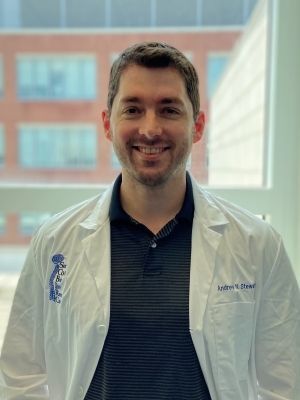
Andrew N. Stewart, PhD
Assistant Professor, Spinal Cord and Brain Injury Research Center (SCoBIRC), University of Kentucky
Abstract
Re-Engineering the Standard of Care as a Needed Approach to Treat Spinal Cord Injury
University of Kentucky, College of Medicine, Department of Neuroscience, Spinal Cord and Brain Injury Research Center, Lexington, KY 40536
Tasked with of discussing what needs to change in the spinal cord injury (SCI) research field, an obvious answer emerges; put our obtained knowledge and molecular approaches to use for humans with SCI. While such a grand endeavor is challenged by numerous complexities, our emerging understanding of the SCI pathophysiology has repeatedly supported a need for combinatorial approaches to maximize functional recovery. From acute surgical care and management, to tackling inflammation, to augmenting plasticity, we should not assume a single intervention will maximize recovery; there is a need to completely re-envision our approaches to the standard of care by identifying and applying smaller treatment approaches across the lifespan after SCI. How do we, as a field, come together to merge our understanding of the SCI pathology to start integrating a holistic approach to recovery? What is needed in the field to start putting our extensive knowledge and molecular approaches to work for human SCI? As we enter a golden age of medicine, we are presented with opportunities to assimilate applied-science approaches into our currently robust infrastructure for discovery and innovation. There remains a need to leverage our animal models to strengthen pipelines of preclinical-to-translational efforts and to create incentives that promote forward progression from basic science discoveries into clinically minded treatment approaches. By re-envisioning an SCI treatment not as a single drug, but as a package of smaller combinatorial approaches applied across the lifespan, perhaps we can present a re-engineered standard of care that leverages decades of accumulated knowledge from animal models to maximize recovery potential.
Bio
Dr. Andrew N. Stewart, PhD is an assistant professor within the Spinal Cord and Brain Injury Research Center (SCoBIRC) at the University of Kentucky. He received his PhD at Central Michigan University working under Drs. Gary Dunbar and Julien Rossignol working to develop stem cell approaches for spinal cord injury (SCI). For post-doctoral training, Dr. Stewart moved to the University of Kentucky where he worked under Dr. John C. Gensel to elucidate the role of age and sex as biological variables that impact SCI recovery an treatment effects. Now Dr. Stewarts lab develops knowledge and treatment approaches for the chronically injured spinal cord in animal models.