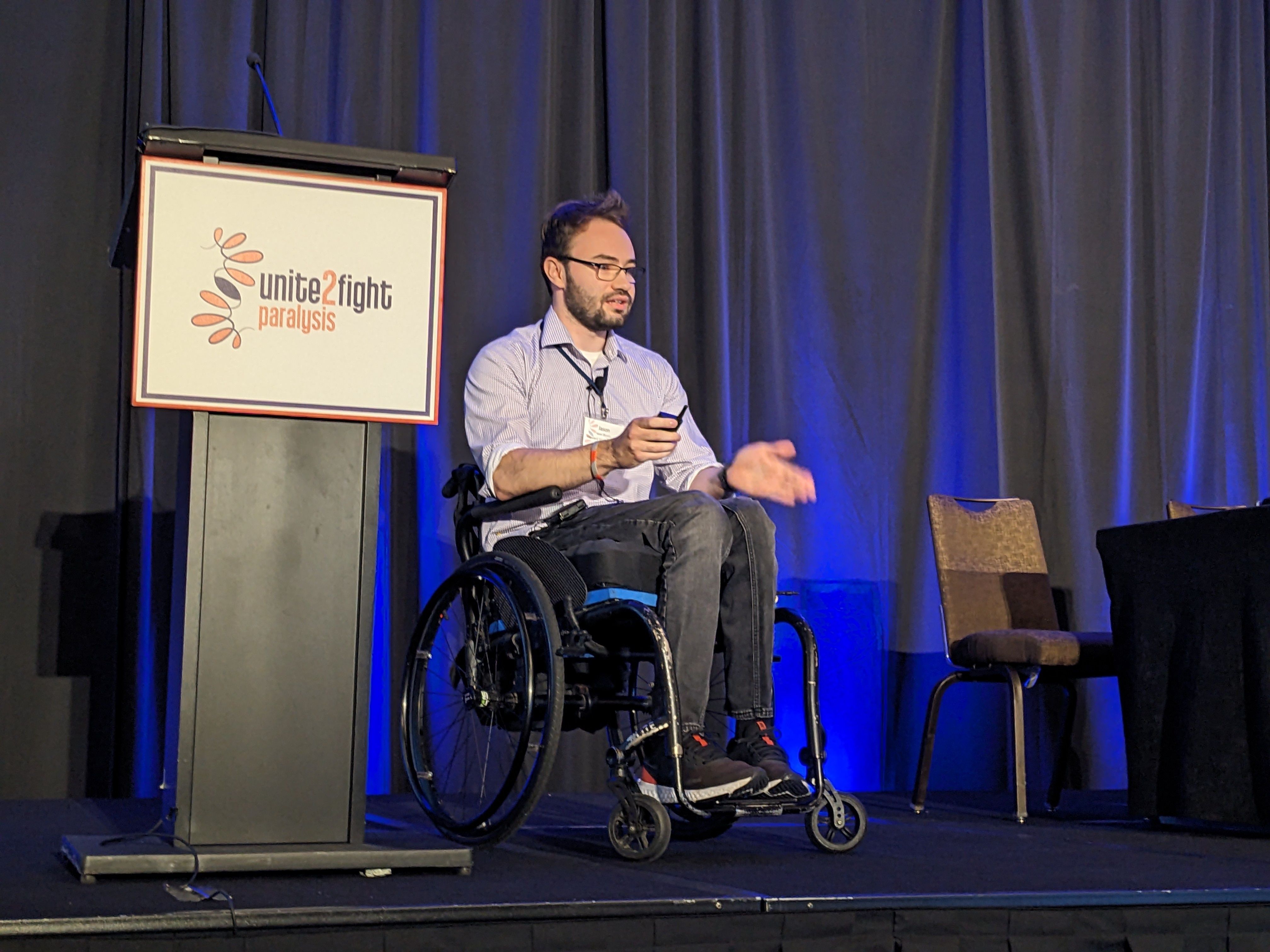
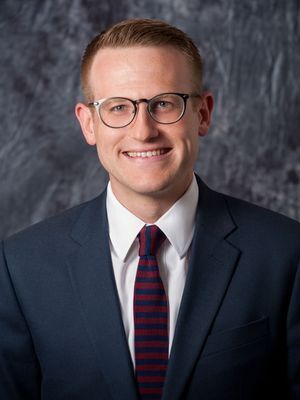
David Darrow, MD, MPH
Assistant Professor, Department of Neurosurgery and Psychiatry, University of Minnesota;
Rockswold-Kaplan Endowed Chair for Traumatic Brain Injury, Hennepin County Medical Center
Abstract
Making Neuromodulation Personal Through Spinal Physiology
Neuromodulation has emerged as a promising approach for improving function and quality of life after spinal cord injury, yet outcomes remain highly variable across individuals. Patients and clinicians are often left without clear explanations for why stimulation helps one person, one function, or one moment in time, but not another. A central limitation is that most neuromodulation approaches rely on stimulation parameters as a proxy for effect, rather than directly measuring how an individual spinal cord responds to stimulation. Our work focuses on using evoked compound action potentials (ECAPs) as a direct physiological measure of spinal cord responsiveness during neuromodulation. ECAPs provide real-time feedback about neural recruitment, allowing stimulation to be grounded in biology rather than trial-and-error programming. Using high-resolution spinal stimulation combined with EMG and physiological mapping in people living with spinal cord injury, we are characterizing how spinal responses vary across individuals and across different physiological states. This approach is designed to be scalable and compatible with existing neuromodulation technologies. By revealing how stimulation engages spinal circuits in each individual, ECAPs offer a pathway toward more personalized, transparent, and interpretable neuromodulation therapies. For people living with paralysis, this means moving closer to treatments that are tailored to their unique nervous system rather than relying on population averages. More broadly, incorporating physiological feedback into neuromodulation may help align patients, clinicians, researchers, funders, and regulators around a shared understanding of what therapies are actually doing in the human spinal cord.
- Project Name
Physiological Personalization of Spinal Cord Neuromodulation - Funding Sources
Minnesota Spinal Cord Injury and Traumatic Brain Injury Research Program; University of Minnesota; Hennepin Healthcare - Publications / Links
Representative publications and ongoing work available at: https://restorativeneurotraumalab.org/ or www.estand.org
Bio
Dr. David Darrow is board-certified pain and functional neurosurgeon, Assistant Professor in the Department of Neurosurgery and Psychiatry at the University of Minnesota and the Rockswold-Kaplan Endowed Chair for Traumatic Brain Injury at Hennepin County Medical Center, specializing in functional and pain neurosurgery. Dr. Darrow treats diseases of the central nervous system with neuromodulation including epilepsy, movement disorders, trigeminal neuralgia/facial pain, chronic pain, and psychiatric diseases.
Dr. Darrow is co-PI of the Herman-Darrow Human Neuroscience Lab with a mission of understanding and treating disorders of the nervous system with neuromodulation. The Herman-Darrow Lab links together circuit-level electrophysiology with behavior. Dr. Darrow is also the PI of the Restorative Neurotrauma Lab at HCMC where electrophysiology and neuromodulation are used to better understand and treat traumatic injuries of the central nervous system. He is the PI for the E-STAND trial, where neuromodulation is used to restore function after Spinal Cord Injury. In collaboration with many other investigators, the team is testing neuromodulation to restore volitional movement and autonomic function using algorithmic, personalized approaches through remote data collection.