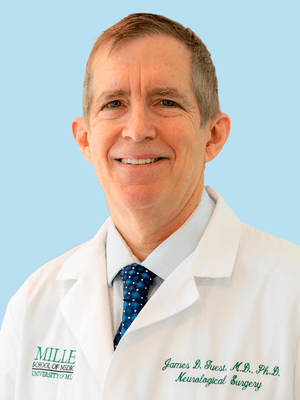
James D. Guest, MD, PhD, FAANS
Professor, Department of Neurological Surgery and The Miami Project to Cure Paralysis
Abstract
Enhancing Recovery After Spinal Cord Injury: Drugs, Biologics, and Neurotechnology
Recovery after SCI has improved with significant advances in acute surgical care, reducing secondary injury and preserving neurological tissue. At the same time, SCI demographics have shifted, with fewer complete injuries and a growing proportion of individuals injured at older ages, often with medical comorbidities. Incomplete injuries generally have better recovery potential, but studies have also shown that no single drug or biologic is likely to produce large, easily detectable effects in the biologically complex injury of SCI.
Current therapeutic strategies increasingly emphasize combination approaches, integrating optimized care, drugs, biologics, neuromodulation, and rehabilitation to achieve synergistic effects. In parallel, clinical trial methodology has evolved, with growing recognition that rigorously designed Phase 2 studies are essential to establish the biological signal, target engagement, dose, timing, patient selection, and appropriate outcomes before committing to pivotal trials. Some costly trial failures can be traced to gaps in preclinical foundations or early clinical development. We are moving toward SCI platform trials, which allow multiple therapies to be tested, refined, and combined more efficiently within a shared infrastructure.
Future progress depends on strengthening the preclinical-to-clinical continuum to mitigate failure risk. Improved prediction and outcome assessment, incorporating fluid biomarkers, neurophysiology, advanced MRI, and functional measures, can better identify responders and detect subtle treatment effects. Modest tissue preservation can support substantial recovery, but motor improvement is not always straightforward and may be accompanied by challenges arising from neuroplasticity, such as spasticity. AI can enable remarkable learning from complex multivariate datasets. Neuromodulation represents a complementary therapeutic paradigm that amplifies residual function or provides a technological bypass linking the brain to preserved spinal circuits, enabling function even without anatomical repair. Moving forward together will increase coordination of optimized care, shared data, biomarker discovery, and coordinated therapeutic systems focused on outcomes most important to people living with paralysis.
Bio
Dr. James Guest, MD, PhD, FAANS, is Professor of Neurological Surgery at the University of Miami and The Miami Project to Cure Paralysis. He has conducted spinal cord injury (SCI) research for over 30 years, beginning in medical school and continuing through neurosurgical training at the University of British Columbia. He earned his MD with research honors from the University of Alberta and a PhD in Neuroscience from the University of Miami, where his work focused on autologous cell transplantation and chronic SCI pathology. Board-certified in Canada and the United States, he completed advanced spinal surgery training at the Barrow Neurological Institute. His research spans late-stage preclinical models to pivotal clinical trials, emphasizing neuroprotection, regeneration, neuroplasticity, rehabilitation, and invasive and non-invasive neuromodulation. He has developed large-animal models used to evaluate biologics and spinal cord and deep-brain stimulation. Funded by the NIH, DoD, and others, he holds leadership roles with the Reeve Foundation, Spinal Research UK, and is Co-Chair of the North American Clinical Trials Network and Registry for acute SCI.