August 24, 2026
Headline Patrol: Brain Computer Interfaces Lead to Movement, Sensation & Commercialization?
Sam Maddox
Two intriguing SCI research headlines appeared recently. One seemingly set a new experimental bar for the clinical potential of Brain Computer Interfaces (BCI); the other is a sign that BCI is becoming an internationally competitive and bankable business, starting in China.
The first headline features Keith Thomas, now 48, who broke his neck in a diving accident at C4 and C5 six years ago. At that time he could not lift his hands from his lap. But after participating in a lengthy combinatory neuromod/BCI/FES “double bypass” study at the Feinstein Institutes for Medical Research in Manhasset, New York, he could lift his arms and grasp a cup to bring it to his mouth. What’s more, Keith recovered sensation in his hands. And he could pick up an eggshell without breaking it, even blindfolded.
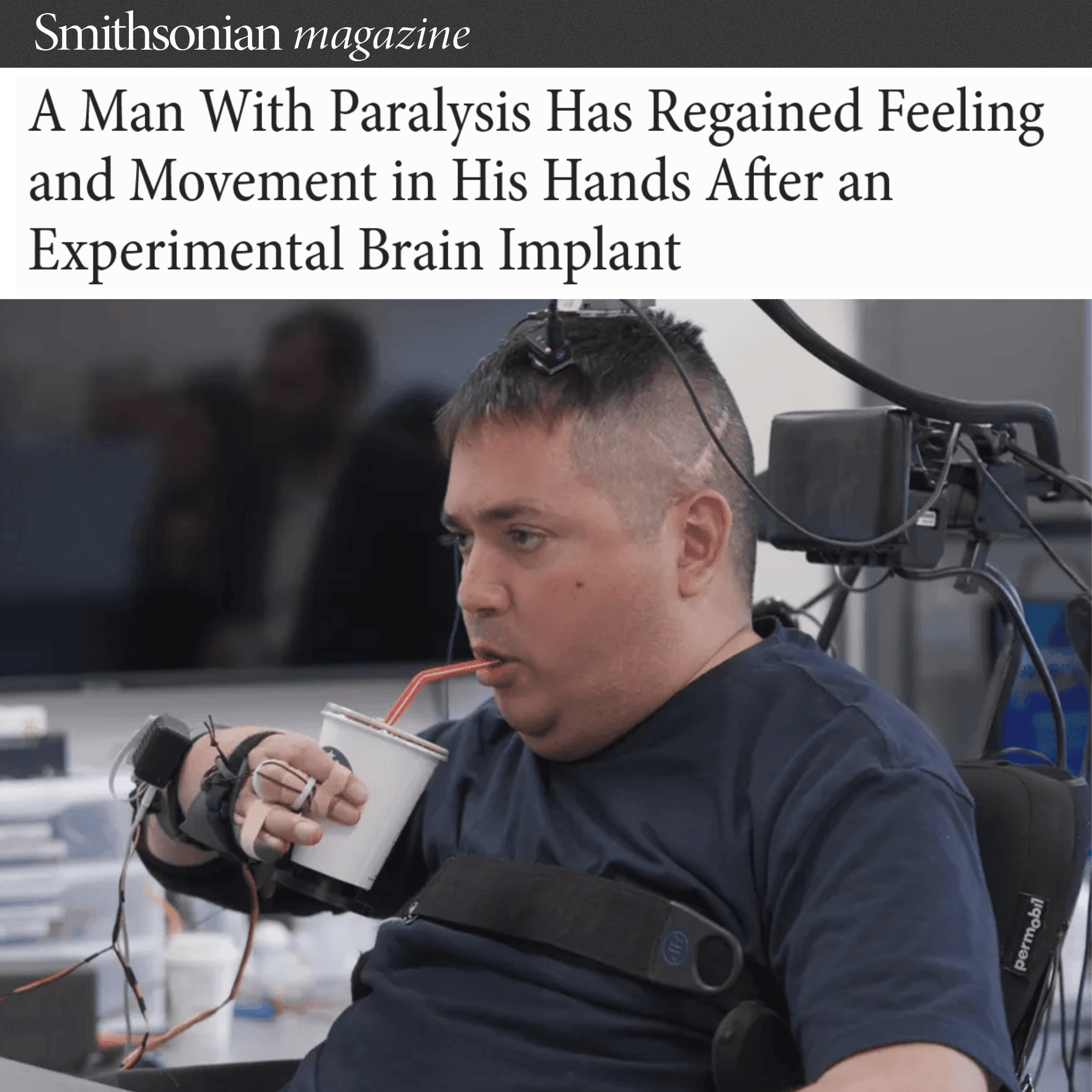
Keith Thomas is now able to grasp, lift and drink from a cup on his own. Feinstein Institutes for Medical Research
Recovery? Clearly meaningful. This study makes a strong case for BCI’s upside. Look at this video (at about the 35 second mark) of Keith holding - and feeling - his sister’s hand for the first time in years. It is a sweet moment. Here’s Keith:
OK, very cool. We’re happy for Keith, great work scientists, but let’s not lose perspective: this is an experimental, highly controlled, N of 1, proof of concept study. It’s far from being ready for clinical use. This is a single participant who spent several years of his life training, being operated on and having electrode implants the size of Zippo lighters embedded in his skull. Here’s the publication about Keith’s study, from Nature Medicine: A neuroprosthesis for restoring hand movement and sensation in a person with complete tetraplegia. |
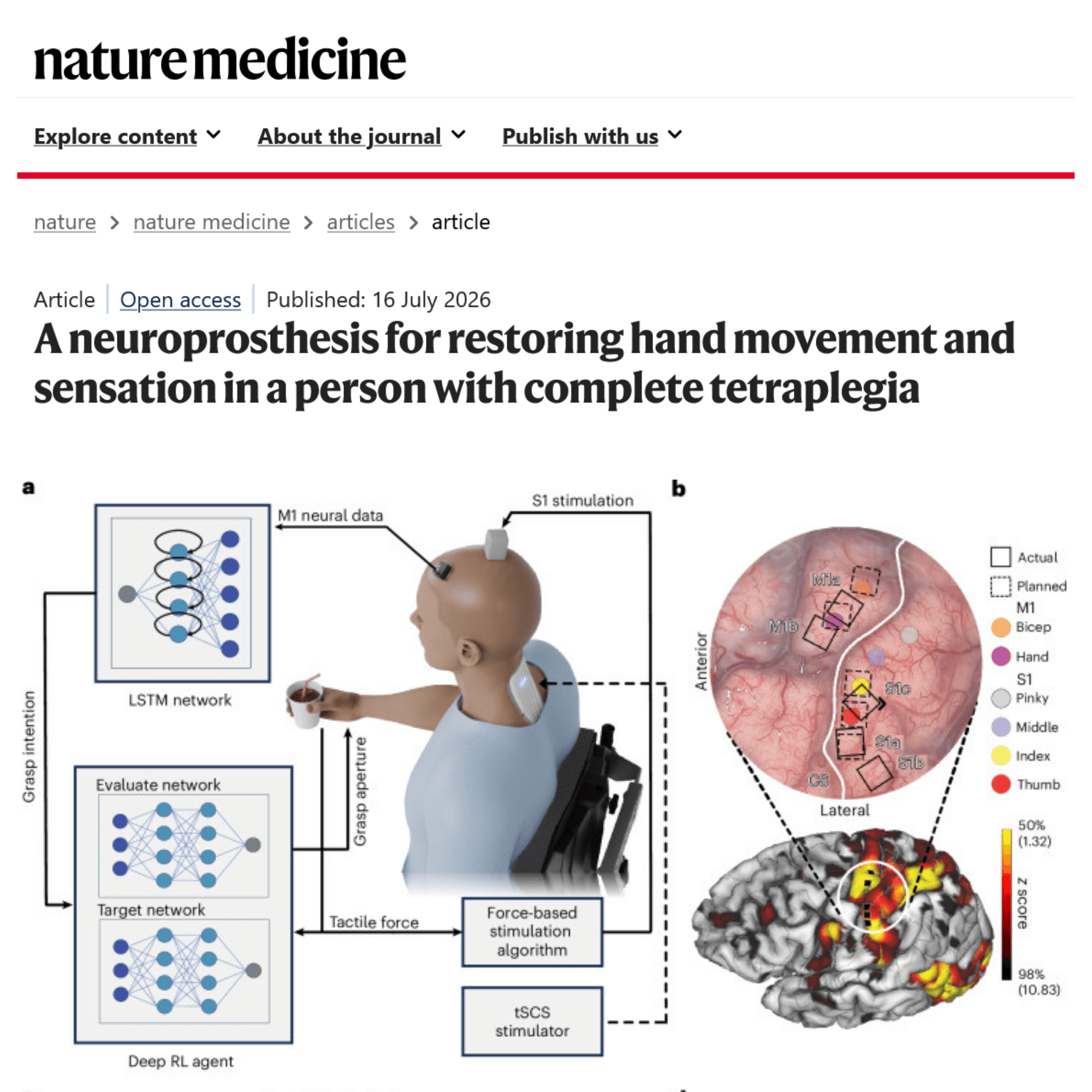
Chandrasekaran, S., Wandelt, S.K., Jangam, A. et al. A neuroprosthesis for restoring hand movement and sensation in a person with complete tetraplegia. Nat Med 32, 2591–2601 (2026). https://doi.org/10.1038/s41591-026-04498-0
The first part of the study, done four years ago, used transcutaneous spinal cord stimulation (tSCS), accompanied by a lot of PT, to effectively double his arm strength.
(Note: tSCS is of course common these days; two FDA approved devices, ONWARD Medical’s ARC-EX and Aneuvo’s ExaStim, are widely in use in both clinical and home settings. The Feinstein study, which produced a particularly good result, applied their own custom investigational stim device to increase Keith’s spinal cord activity.)
In the next phase of the study, done three years ago, Keith underwent a 15-hour open brain surgery, implanting two BCI units (from Blackrock Neurotech, which provided some financial support for the study). One implant picks up brain signals related to motor function, the standard BCI modality – brain waves are translated by computer to control a cursor or device.
The real groundbreaking part, said Principal Investigator Chad Bouton, is placement of the second set of electrodes to read the brain signals related to hand function intent. fMRI was used to pinpoint the exact brain circuits for thumb and forefinger movement, verified by wakening Keith during surgery and asking him to confirm sensation in his hand. They call this cortical mirroring. It records the signals then replays them into the nervous system.
I interviewed Bouton, a BCI veteran who did his first human brain implant 23 years ago:
We did many months of spinal cord stimulation, transcutaneous, but did not see an improvement in his sensation. So we combined that with cortical mirroring, where we recorded the micro patterns in his brain, in and around the hand area, the sensory area.
And then we played those same exact micropattern signals back with what's called high frequency modulation. After only a few weeks, we saw a tenfold improvement in Keith’s sensation.
From the paper:
Here we report a double neural bypass (DNB), a hybrid neuroprosthetic system designed to restore both immediate and lasting gains in movement and sensation after a severe, complete spinal cord injury. The DNB links an intracortical brain–computer interface with targeted and patterned neuromodulation of the spinal cord and cortex. This allows brain signals associated with movement intention to directly control the movement of the user’s own hand in real time while also promoting long-term sensorimotor recovery—even after the system is turned off.
From a Feinstein press release:
Advanced machine learning algorithms decode movement intentions from brain signals with remarkable consistency, achieving up to 84.6% accuracy sustained over five months without requiring any retraining.
A third part of the study gave Keith fine hand function by way of a custom functional electrical stimulation (FES) system on his wrist and forearm. Using a flexible plastic sleeve embedded with skin-surface electrodes, Keith was able to consciously activate his movement intentions and fire the appropriate muscles in his hand to activate an orthotic device. Said Bouton, “This is the highest resolution FES system in the world now, as far as we're aware.”
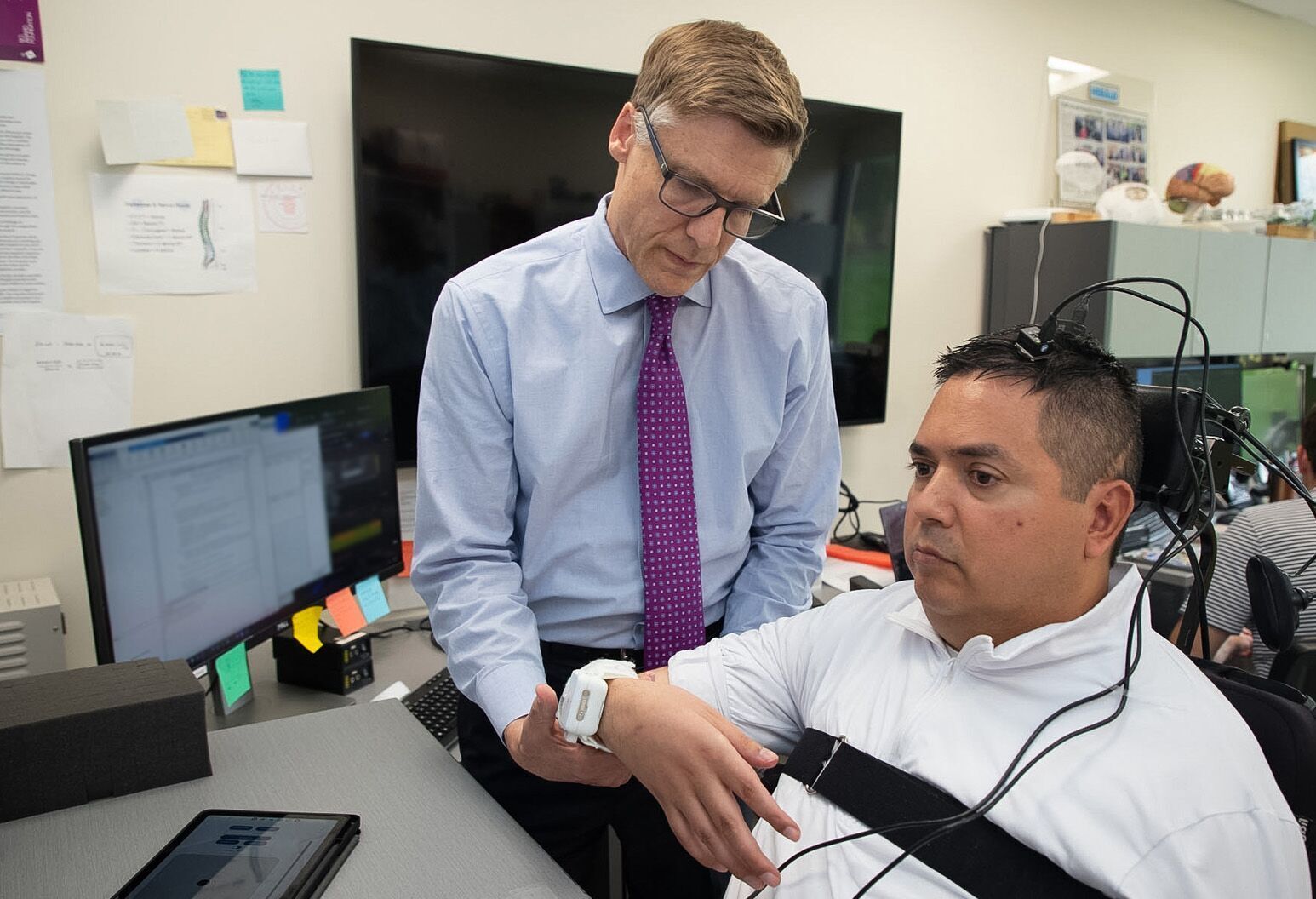
Chris Bouton (left) with Keith Thomas (right). Image courtesy of Chris Bouton.
From Feinstein:
When Mr. Thomas thinks about moving his hand, AI helps translate those neural signals into precise patterns of electrical stimulation delivered to muscles in his forearm, moving his own paralyzed hand. Simultaneously, force sensors embedded in a custom 3D-printed orthotic device measure pressure during grasping and trigger electrical stimulation patterns in the brain’s sensory cortex, creating the perception of touch in specific locations on the hand.
The system’s precision enables extraordinarily delicate control. Mr. Thomas successfully grasped and lifted hollow, empty eggshells 87% of the time without breaking them.
(Note: Bouton told me that a company he started, Neuvotion, is soon launching a product, NeuStim, similar to the FES hand system Keith used. This flexible, non-invasive sensor array is intended to help people with hand impairment due to stroke or SCI. The FDA-approved device features an Apple watch type artificial intelligence control.
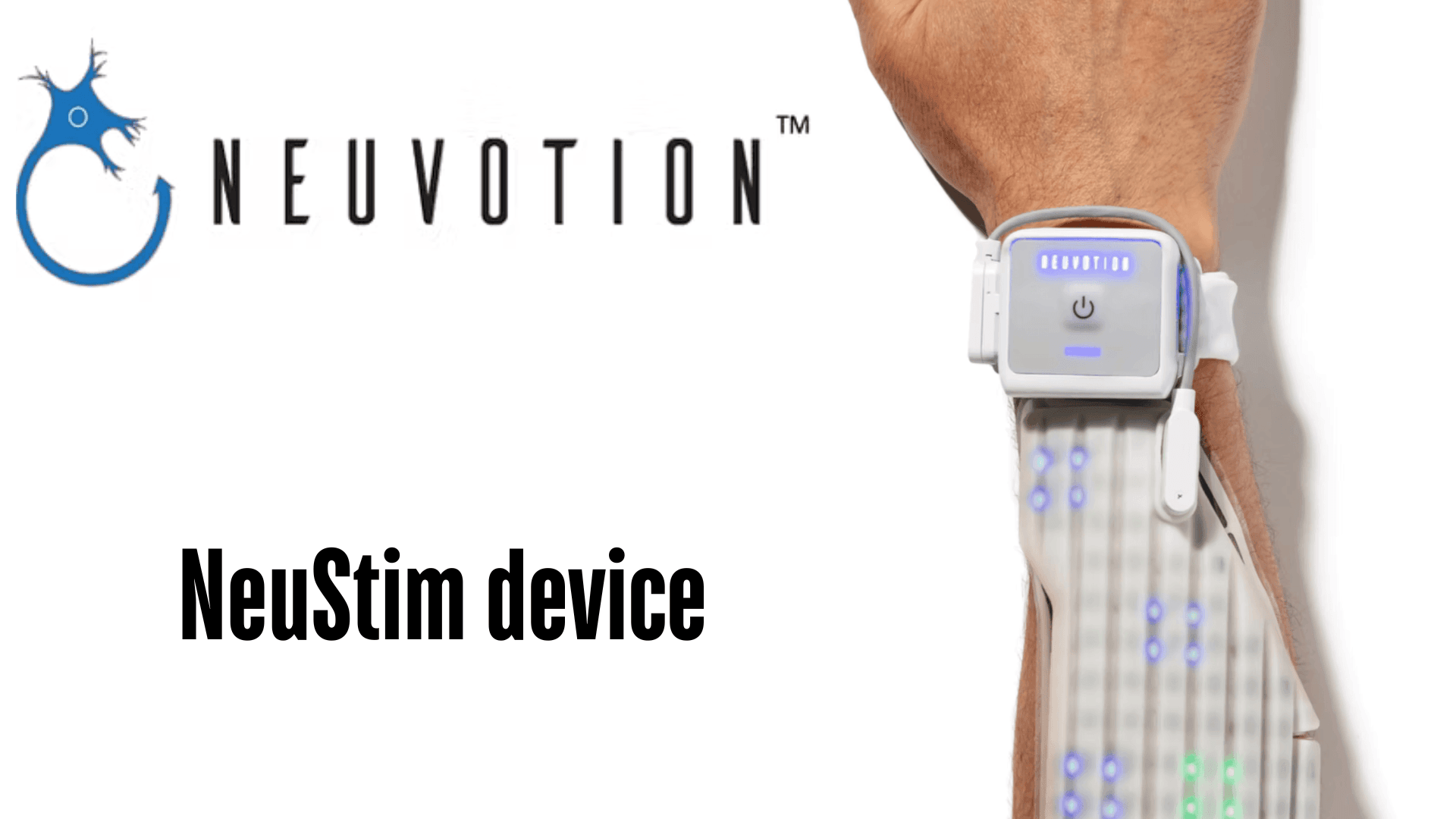
Said Bouton, “Someone who's completely paralyzed just has to initiate motion, and the AI infers from that, based on great data we have. We've had people feed themselves, pick up granola bars or pop cans, pick up utensils, brush their teeth.”
Promoting Nervous System Plasticity
Bouton reported that the experimental stimulation combinations appear to promote lasting nerve growth, or neuroplasticity. “With this approach,” he said, “we could not only restore immediate tactile sensations but [also] promote lasting improvements in sensation, even when the bypass was turned off.”
Bouton, from a press release:
This approach is a new way to treat severe paralysis — we’re not just bypassing the injury; we’re actually rewiring the nervous system. Our team of engineers, neurosurgeons, and clinical research staff accomplished something that’s never been done before.
Said Bouton, “We turned everything off completely, at one time for three months, and yet he’s maintained these gains. That’s unheard of.”
China Says Game On, the BCI Race Has Begun
A BCI device called Neural Electronic Opportunity (NEO), from a Chinese company called Neuracle, got market approval last March by Chinese regulatory agencies – the first such approval of BCI in any country.
In July, the first prescription for NEO was written and the first clinical implantation surgery was performed at Huashan Hospital, Shanghai. Per news from Chinese media, the BCI enabled a spinal cord injured patient with hand dysfunction for 10 years to regain grasping function while using a special robotic glove.
Technically, the NEO is not making much of a stir. BCI has been moving hand prosthetics for 20 years. But the main feature of NEO is its minimal invasiveness. It’s a coin-sized wireless array that is implanted under the scalp but not inside the brain’s dura mater. Like all BCIs, it reads the motor cortex, sends the signals to a computer for translation into electrical signals that activate a prosthesis, in this case, a robot hand.
The approval of NEO is based on a 36-participant clinical trial that showed efficacy across the board and no serious adverse events after 18 months of follow up.
Some fair questions: how rigorous is China’s approval process? Is there any form of peer review? What are the standards for evidence or informed consent processes? Is there any post-market data collection? What about protections for users if companies go out of business? None of these questions are explicitly addressed by Chinese regulators or the foreign press.
Neurotech.com, a news and information resource for the neuromod and BCI communities, commented on the China BCI gambit:
China has made no secret of its strategic interest in brain-computer interface technology, positioning BCI development as a national priority alongside artificial intelligence and advanced semiconductors.
For Western firms and their investors, this [commercial implant] is a signal that the window for establishing global market leadership is narrowing, and that competitive pressure will increasingly originate from Chinese developers with strong state backing and access to large patient populations for ongoing data collection.
Paradromics is a Texas-based company in the BCI space now running a clinical trial to enhance communication via brain signals to text. Recently the company posted a blog about the Chinese first-to-market story, noting that the underlying tech “would be hard to position as ‘leading internationally’ in the way that some headlines have implied.”
They also point out that regulatory approval does not equate to commercial success. Translation: who is going to pay for this?
From the blog:
This device cost [$40,000 to $69,000 USD] is not yet reimbursable by government healthcare. The government-set procedure service fee is set at $900 – significantly less than the total device cost. The first surgery performed under China’s government-guided pricing framework at Wuhan Tongji Hospital in December 2025 was funded solely by research grants.
This shows that while China has granted regulatory approval, they have not yet elaborated a commercially viable path for connecting broader patient populations to their devices.
Is China the BCI leader now? Paradromics sees their advantage:
For a pure technology standpoint, no. However, it is arguably more progressive in its regulatory and administrative coordination – and that is the real strategic advantage.
Chad Bouton, of the aforementioned Feinstein study, chimed in: “We here in the U.S. are going to continue to innovate, and hopefully stay ahead. You know about American ingenuity, and our drive.”
Musk vs. Altman
Talk of BCI requires an obligatory mention of Neuralink, the Elon Musk company testing its Telepathy BCI in humans. Users directly control video games, computers and prosthetic devices solely with their thoughts. The company website indicates that more than 20 implants have been done; I suspect that number is low.
Neuralink is much more aggressive about using robotic surgery to bury its sensors deeper into the brain matter. That ambition may require long term safety data (is it even possible to explant one?) so there’s no clear pathway at this time for the company to seek regulatory approvals.
But wait! Musk and the rest of the BCI field has a new competitor – another Silicon Valley tech billionaire, Musk’s arch enemy Sam Altman. This is the Open AI bro who beat Musk earlier this year in a three week trial (that might well have been settled by the two tech dudes using a tape measure in the men’s room) to determine whether Altman had stolen a charity they co-created. The jury took less than three hours to decide he didn’t.
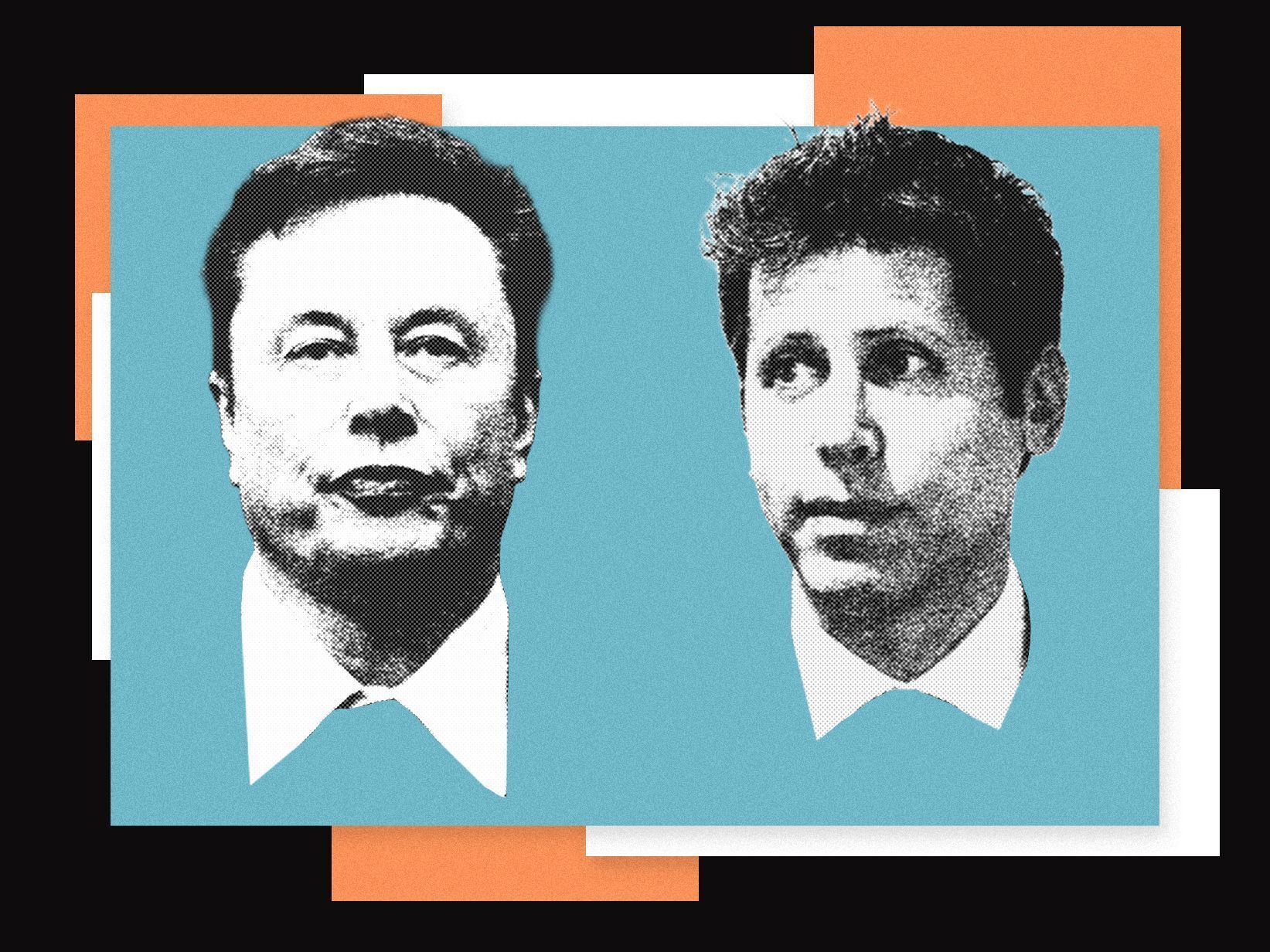
Neither of the tech titans came out of the trial looking very wholesome, likeable or trustworthy. Headline in the New Yorker: “Sam Altman Won in Court Against Elon Musk. But, Really, We All Lost.”
Now comes Altman’s entry into the BCI field, Merge Labs, with hopes to develop an even less invasive modality, using ultrasound on gene-altered brain cells. He’s clearly less interested in meeting an unmet medical need than he is in creating super humans.
A merge, said Altman back in 2017, is our “best-case scenario” for humanity surviving against superintelligence AI, which he describes as a separate species in conflict with humans.
OK, slow down, let’s look at what’s possible now. The man-machine merge is concerning but on the way to the super humans of the future, BCI studies like the one here with Keith are important steps toward therapies and meaningful improvements in quality of life.
Stay curious.