

November 3, 2026
Headline Patrol: World’s First Spinal Cord Transplant?
Sam Maddox
A Chinese surgeon working in Moscow says he performed a spinal cord transplant. The story was reported by the surgeon, a man whose participation instantly raises the caution flag. It was also confirmed by the mayor of Moscow, though I have no idea why except for nationalistic pride.
Xiaoping Ren, an orthopedic surgeon at the Second Affiliated Hospital of Guangxi University of Chinese Medicine, told New Scientist that he led the 12-hour operation at the Sklifosovsky Institute. The patient is described as an adult who has had a complete spinal cord injury for the last three years.
Ren said his team cut out the damaged section of the recipient's cord and replaced it with a section from a brain-dead donor. They then used polyethylene glycol (PEG) and microsurgery to glue the donor tissue into the recipient's cord. No word on any recovery for the patient.
Ren described his transplant idea, which he calls the “GEMINI protocol,” in a 2019 paper, “Bridging the gap: Spinal cord fusion as a treatment of chronic spinal cord injury.” He says this could be “the cure:”
Removing the chronically injured segment of a cord, followed by spinal shortening and PEG fusion of the healthy ends (GEMINI protocol) has the potential to restore motor function in a substantial number of chronically paralyzed (ASIA A) patients for whom no cure is available.
Ahead of the human case, which has not been peer reviewed or published in the literature, Ren has experimented with the cut and PEG process in small animals and recently, in a study with two primates, published in 2024, “Recovery of independent ambulation after complete spinal cord transection in the presence of the neuroprotectant polyethylene glycol in monkeys.”
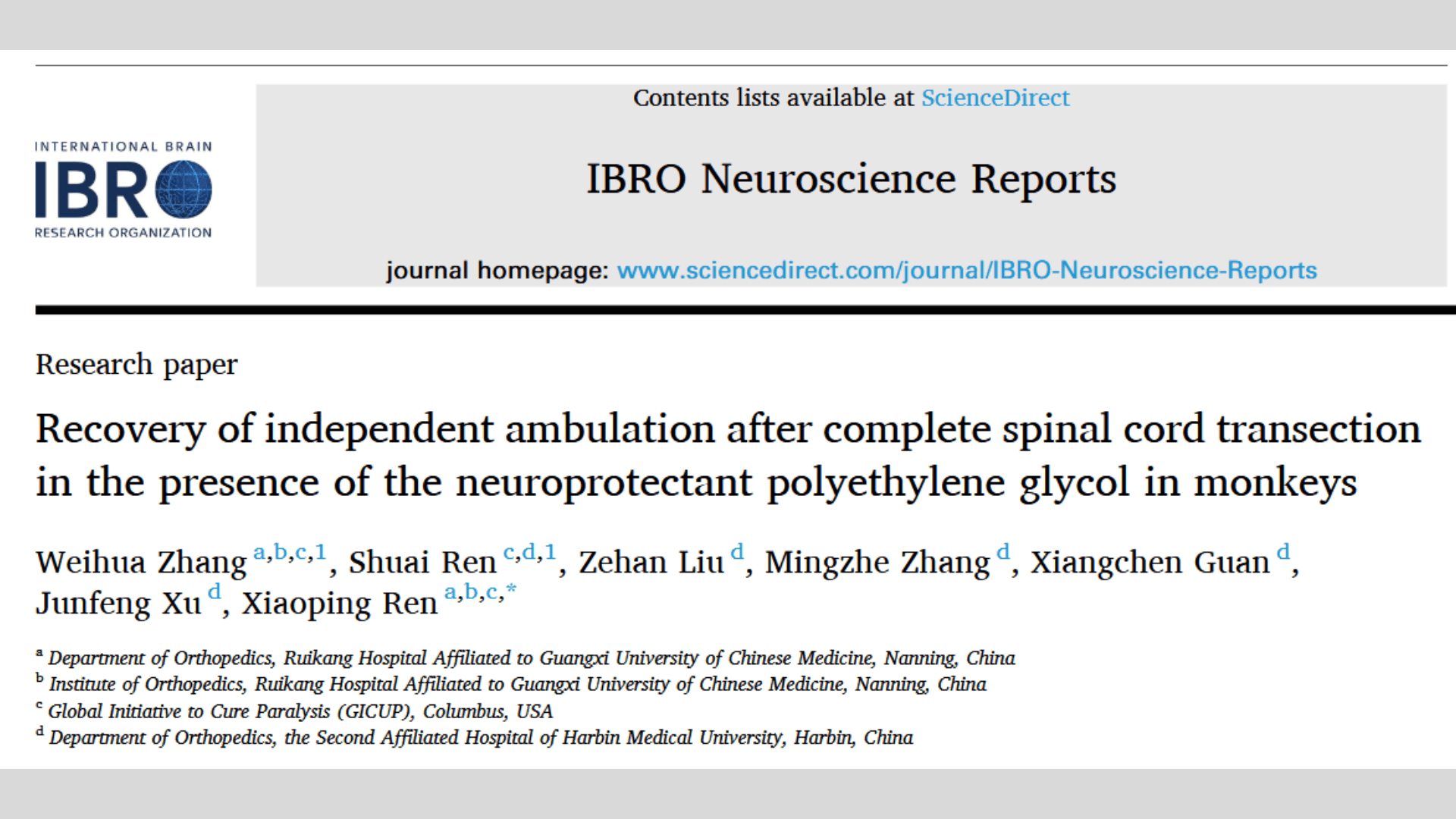
Two Macaca monkeys were paralyzed at the thoracic level (T-10) by sharply cutting their cords. Immediately after injury, one animal got PEG to rejoin the ends of the cord together, and one, the control, did not, The untreated animal remained paralyzed and soon developed severe spinal cord distortion (kyphosis) and was euthanized after a month, “in consideration of the animal's distress and quality of life.”
From the paper, Ren reports “unprecedented levels of motor recovery:”
The monkey whose spinal cord had been fully transected in the presence of PEG developed useful recovery already at 3 months and near-complete recovery of motor function in the hind-limbs at 18 months. The control animal without PEG remained paralyzed.
How does this work? Ren et al say it’s not about reconnecting the millions of long axons from the brain descending to the lower extremities. It’s about protecting all the shorter, densely packed interneurons in the cord. Ren and his group note that “perfect one-on-one axonal alignment is impossible.” But if enough axon ends find a partner across the cut, even just 10 percent, and if the interneurons remain viable and make new relays, that appears to be enough for meaningful recovery.
Ren’s Back Pages
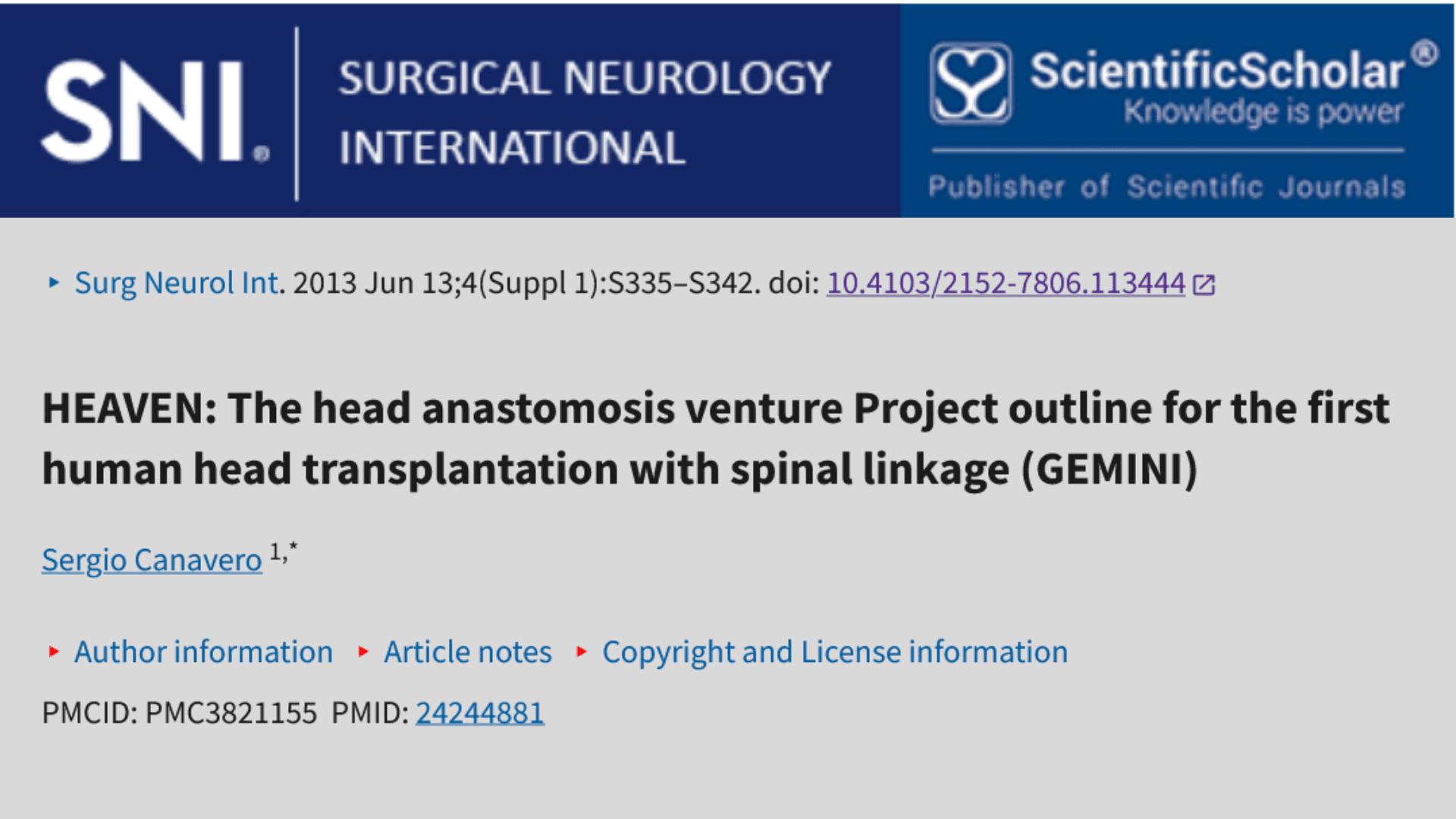
Here’s the tea on Ren. He was all over the tabloid wire a few years ago, teamed with an Italian doctor, Sergio Canavero. They announced their intention to transplant the head of a guy with cervical spinal cord injury to a cadaver body. Canavero details the procedure in this 2013 paper.
Chicago racers and supporters gathered for a rooftop party after the race on October 11th.
The protocol involved a lot of very sharp precision cutting, cooling, microsurgical vascular surgery, immune suppression, etc. The major issue: connecting the two spinal cords.
Thankfully, the live human head swap never happened, but it stirred up a lot of technical and ethical issues. What is the source of donor bodies? What about pain? Infection? How can a brain recognize the uniquely different wiring and biochemistry of a new body?
Meanwhile, if the notion of a human spinal cord implant sounds simpler, it is no less challenging. Technically and ethically. Where does the donor cord come from? Can the new tissue be recognized as a patch or is it a big invasive immune bomb? How does all that animal work with clean-cut acute injuries predict outcome in chronic SCI?
If Ren et al publish peer-reviewed details of the Moscow operation, and are transparent about the risks and benefits, great, let’s hear more. Until then, this stays in the tabloid drawer.
Stay curious.