Dec 21, 2024
U2FP Wins First-Ever Access for E-Assist Handcycles in a Marathon
Lucia Webb
This is the story of U2FP’s unlikely four year battle (and eventual success) in pushing the Twin Cities Marathon (TCM) to be more inclusive of people with disabilities. In fact, our victory marks the first time any marathon in the United States has allowed the use of e-assist handcrank wheelchairs - a pioneering achievement! Our charity marathon teams play a huge role in fundraising for our work on curing spinal cord injuries. So it didn’t seem right that many people with an SCI who wanted to support us in this way could not be directly involved in those races.
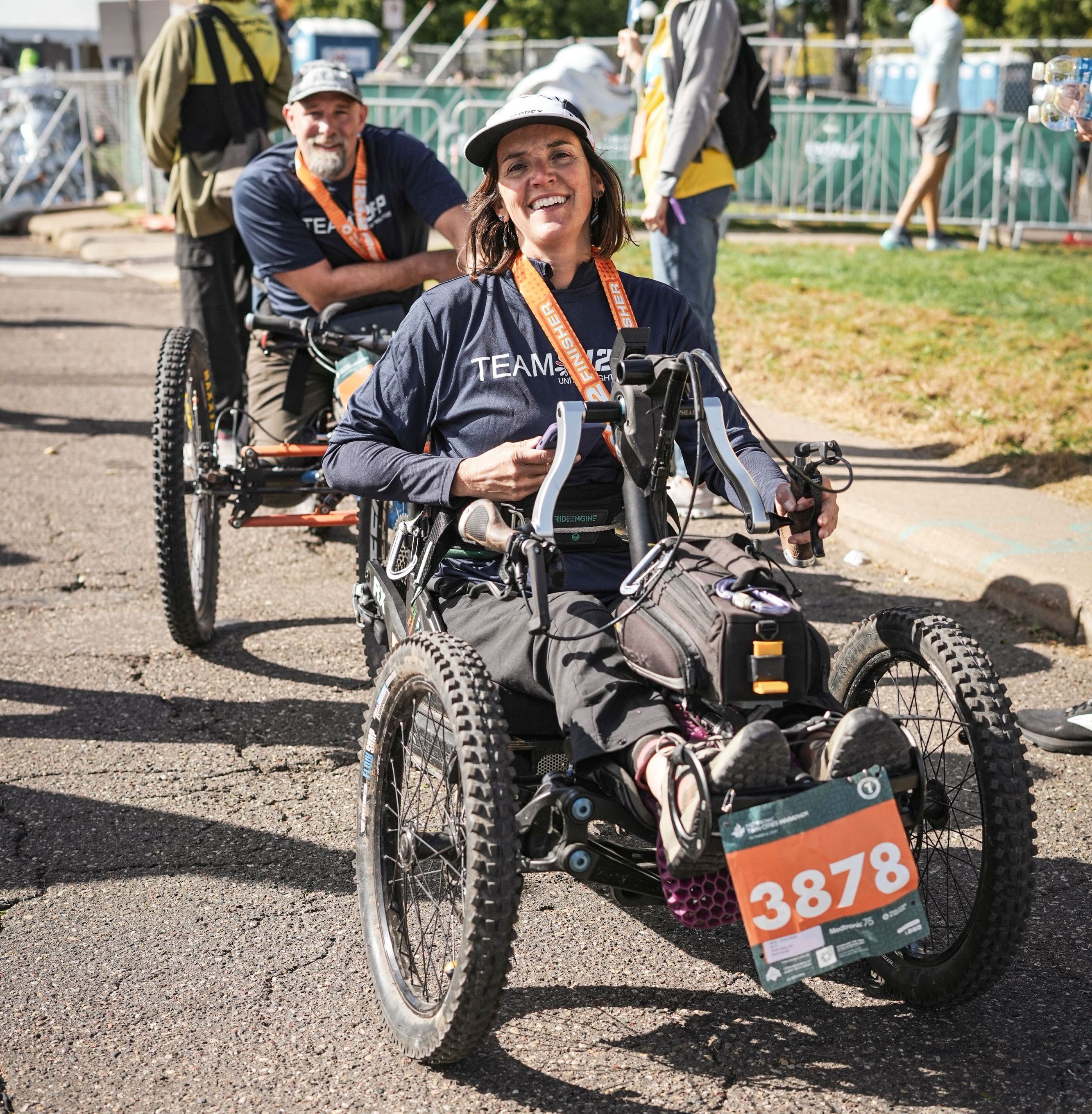
U2FP’s Jason Stoffer and Quinn Brett after the 2024 Medtronic Twin Cities in Motion Marathon - the first-ever marathon to allow e-assist handcrank wheelchairs!
When I started as U2FP’s Operations Director in January of 2021, one of my responsibilities included managing our Team U2FP program, which allows individuals to run or wheel in the race of their choice while fundraising for our work. Though I’d worked at nonprofits previously, and in the disability field in general, I didn’t have much direct experience with the SCI community. In fact, I’ll be honest and say that - until I joined U2FP - the majority of my knowledge about spinal cord injuries was from the TV show Friday Night Lights.
I learned a lot rather quickly: from the serious nature of secondary conditions to the complexity of the research landscape. This made it all the more frustrating to witness the glacial pace of something much more straight-forward: marathon accessibility. TCM race organizers would only allow SCI racers to participate if they had a paralympic-style racing chair (a device in the neighborhood of $20K). No handcycles or any devices with gears, and definitely no e-assist technology.
When our development director, Quinn Brett, came on board at the end of last year, she jumped into our fight for inclusion and pointed out that this restriction was like saying able-bodied runners could only wear one kind of insanely expensive sneakers. Organizers pushed back, saying that it was about the “safety” of all participants and not a simple issue. But I couldn’t shake my belief that the problem was a lack of creativity and flexibility, nothing more.
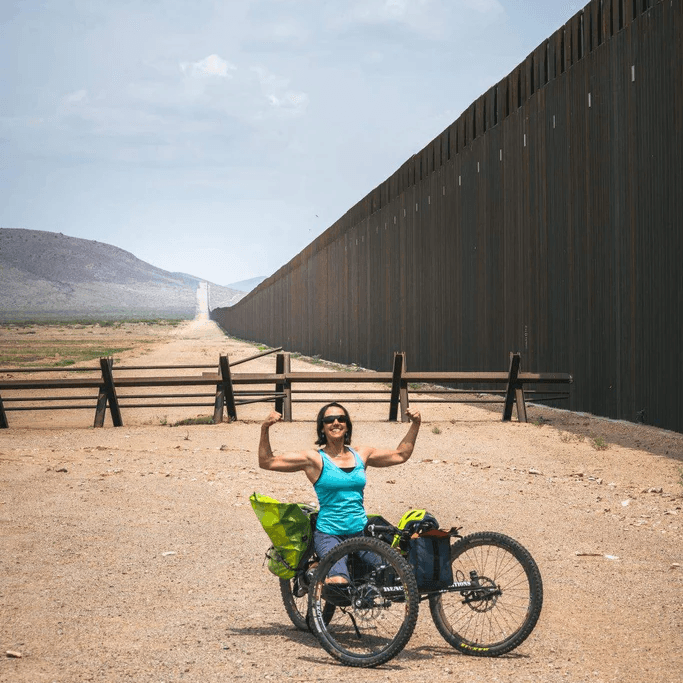
Quinn Brett is no stranger to challenges. Here she is at the US/Mexico border having just completed the Divide Trail on her adaptive trike - a 3000+mile excursion from Canada to Mexico.
In April of 2021, I sent marathon registration instructions to a wheeler, Jake Anderson, only to have his participation denied for the second year in a row, as he would not be using a professional racing chair.
In 2022 we tried again. After hours of meetings, pressure, and vetting by race organizers, Jake was finally approved to participate in his custom tandem trike, with race partner Jack Egbert. We were also given the go-ahead to have one additional wheeler using a “non-traditional racing chair.” However, two weeks before the race, and several weeks after he registered to participate, another one of our wheelers, Joe (who is a quadriplegic with limited hand and wrist function), was denied participation, due to the fact that he would be using a chair with a “traditional handcrank.”
So, mixed results at best. Having Jack and Jake race for our team and wheel their first marathon was huge. But to have Joe’s access allowed and then denied was disappointing. I was extremely frustrated because this was not a physical barrier caused by his injury, but an artificial barrier erected for other people’s convenience (something I had heard plenty of stories about from my SCI colleagues by this time as well). What is marathon participation compared to the multitude of other issues that people with spinal cord injuries face?
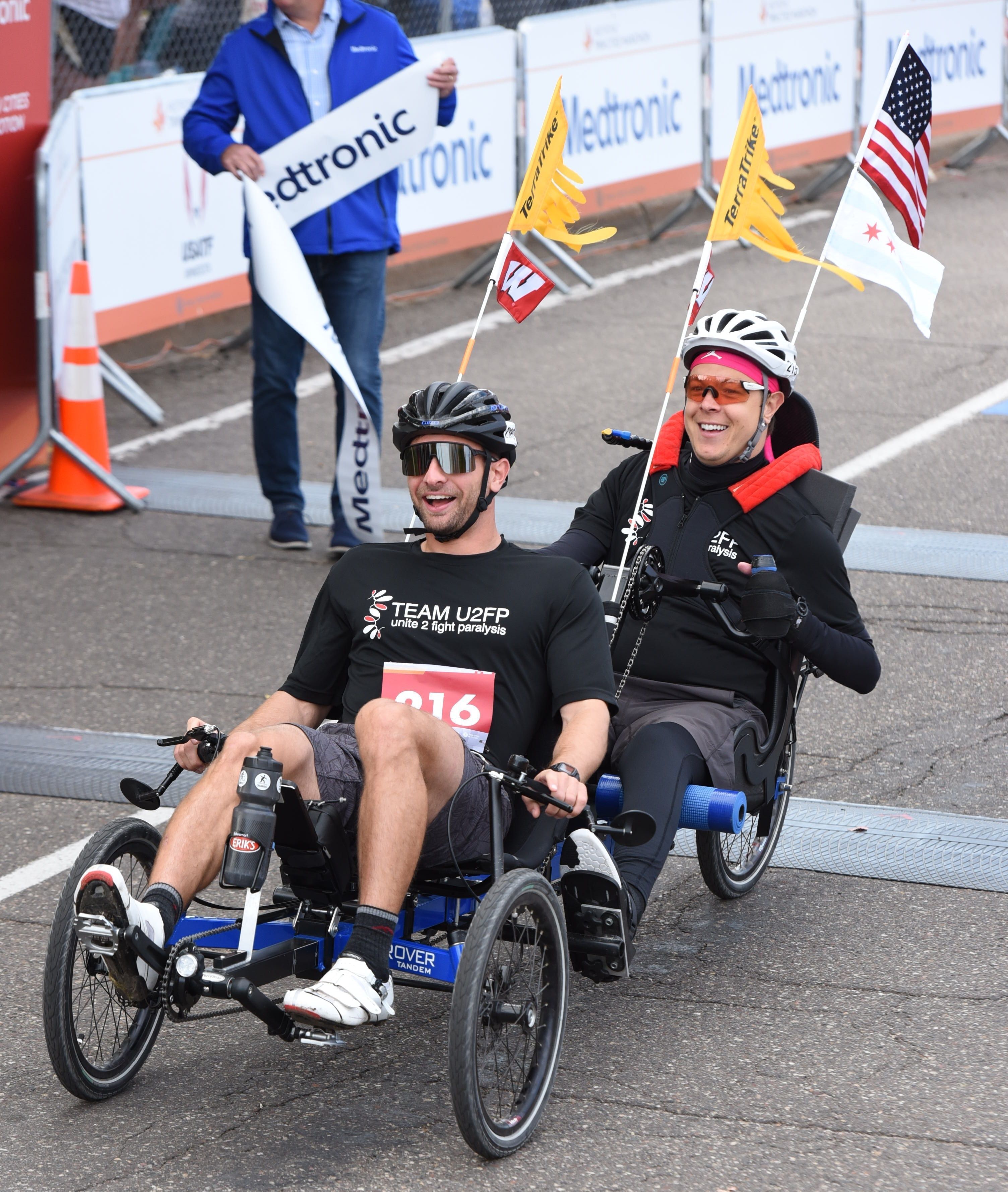
Jack Egbert and Jake Anderson, crossing the finish line at the 2022 Twin Cities Marathon.
2023 brought a frustratingly incremental increase in their allowance of non-professional wheelers. We were “given” two spots for the marathon. They were quickly filled by our two tandem teams: Jake Anderson and Jack Egbert and Jordan Bolton and Josh Nix (Jordan is U2FP’s social media strategist who works out with Jake at Josh Nix’s adaptive gym, Fit 4 Recovery). Joe was once again put on hold by race organizers, for unclear reasons. (By the way, I promise that you’re welcome on our team even if your name doesn’t start with a J.)
If you’re a Minnesotan, you might remember the cancellation of that race due to unseasonably high temps. Unsurprisingly, our racers persevered and cycled 26.2 miles anyway.
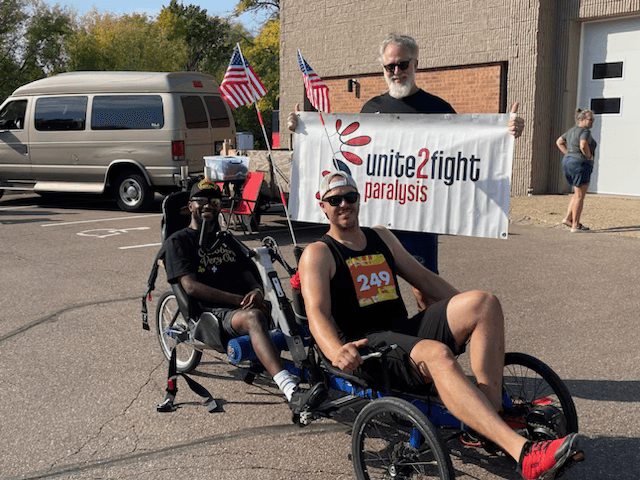
Jordan Bolton and Josh Nix wheeling for Team U2FP in 2023, despite the marathon’s cancellation due to extreme heat.
Finally, at the end of this summer, after years of work, hours of meetings with race organizers, the involvement of multiple lawyers, and communications with the race’s title sponsor, the doors were finally opened to wheelers using handcycles.
And get this - they were also open to allowing the use of e-assist.
As wheelers know better than I do, the admission of handcycles is just the beginning - for anyone but the most fit paraplegic athletes to participate independently, e-assist technology is crucial. Both Quinn and Jason raced in October, as you’ve already heard. But it bears repeating - it was exciting, invigorating, and groundbreaking! I am so proud of them, and of my hometown race for pioneering inclusivity.
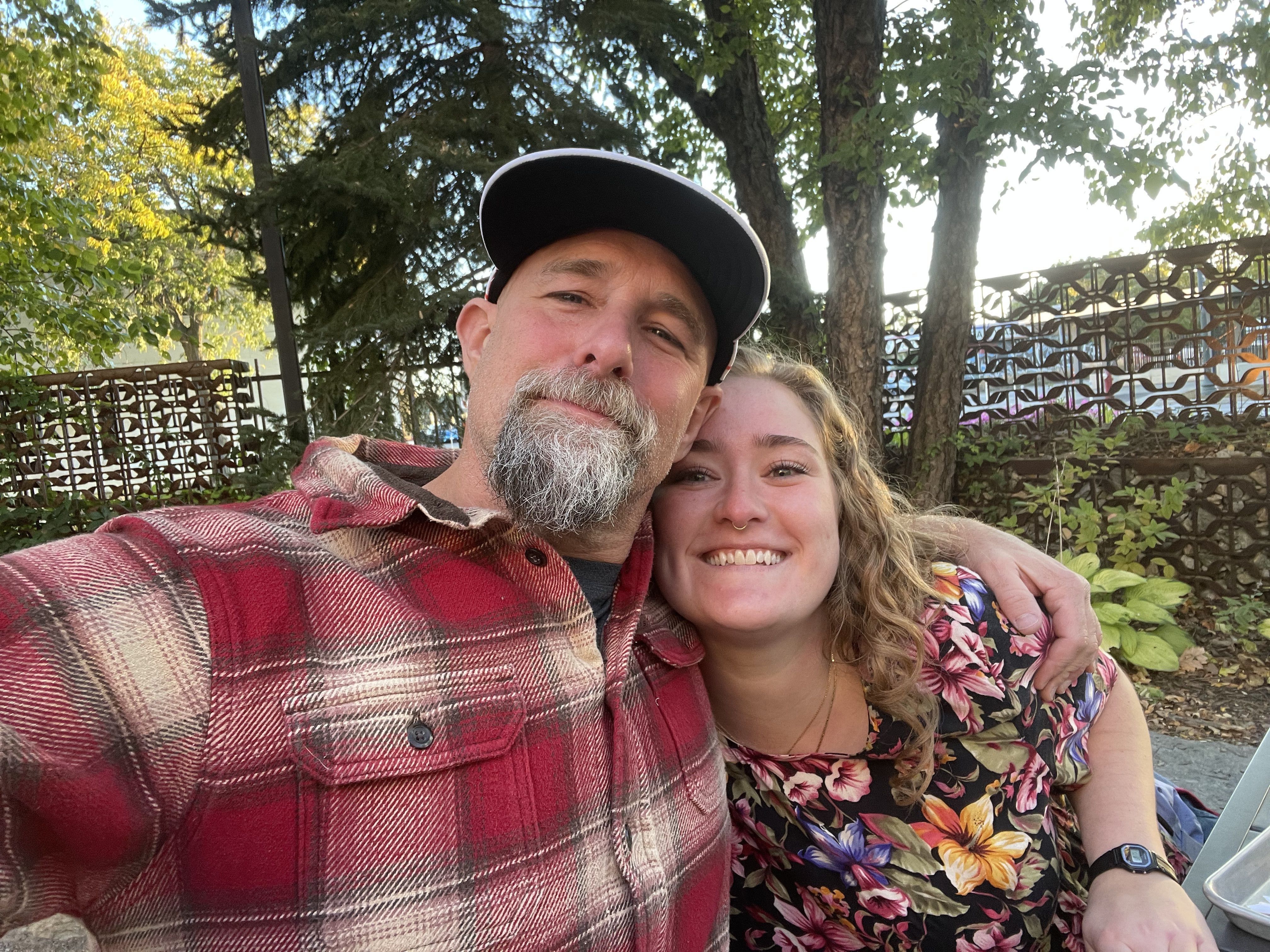
My colleague Jason Stoffer and I take a selfie after his successful completion of the Twin Cities Marathon via an e-assist handcycle.
It took three and a half years, but finally, we had a huge win, as Jason described in his post-race reflection, Getting an Assist: Team U2FP Makes History. And not only were two hand cyclists allowed to participate in 2024 using their e-assist devices, making the Twin Cities Marathon the first to offer that option, the race organizers have since agreed that the 2025 marathon will be open to all wheelers, using any device.
This means that you could race this marathon for Team U2FP, no matter your level of injury, no matter the device you need to move your fastest (email me if you want to pre-register). And I’ll be there to go to bat for you, along with Quinn, Jason and the rest of our staff, if any complications come up, I promise.
PS - Consider making a year-end gift to support all the good work U2FP is doing to fight for recovery of function after spinal cord injury.