Dec 11, 2025
A Small Charity Joins the Battle, Validated by U2FP
Sam Maddox
Unite 2 Fight Paralysis is all about advocacy and community. One part of our outreach, the Scientific Advisory Board (SAB), doesn’t get a lot of attention. Here’s a look at the SAB process and how it helps move SCI research forward. Over the years around $6 million in funding has been approved by the SAB.
In a moment, I’ll describe an ongoing spinal cord injury regeneration project that is being advanced, in part, by a small SCI charity based in the Netherlands. The part funded by this charity was evaluated for scientific merit by U2FP’s SAB.
But before jumping into the details of this bold and innovative science endeavour, here’s why the SAB exists and how it works.
Why This Is Needed
Foundationally, the SAB embodies the notion that impartial scientific review is essential to the integrity and quality of a public or charity-funded research proposal. Having objective experts evaluate the proposed work – who are not aligned with either the funder or the grantee – minimizes conflict of interest and bias, and assures that projects are reasonably priced, and relevant to the mission of the funding group.
Science review is the cornerstone of public and philanthropic research. Government agencies, e.g. the NIH or VA, or larger private charities such as Wings for Life or the Craig H. Neilsen Foundation maintain their own review boards to evaluate projects and rank them for funding. The SAB was started because many smaller charities and foundations do not have access to a review board or review process.
How it Started
In 2012, Chicago area paraplegic Geoff Kent created an organization called SCI Sucks to direct people new to paralysis to information resources, and to fund SCI research. Kent and a few friends, racing as Team U2FP, wheeled in the 2012 Chicago Marathon*, raising $50k for SCI cure research.
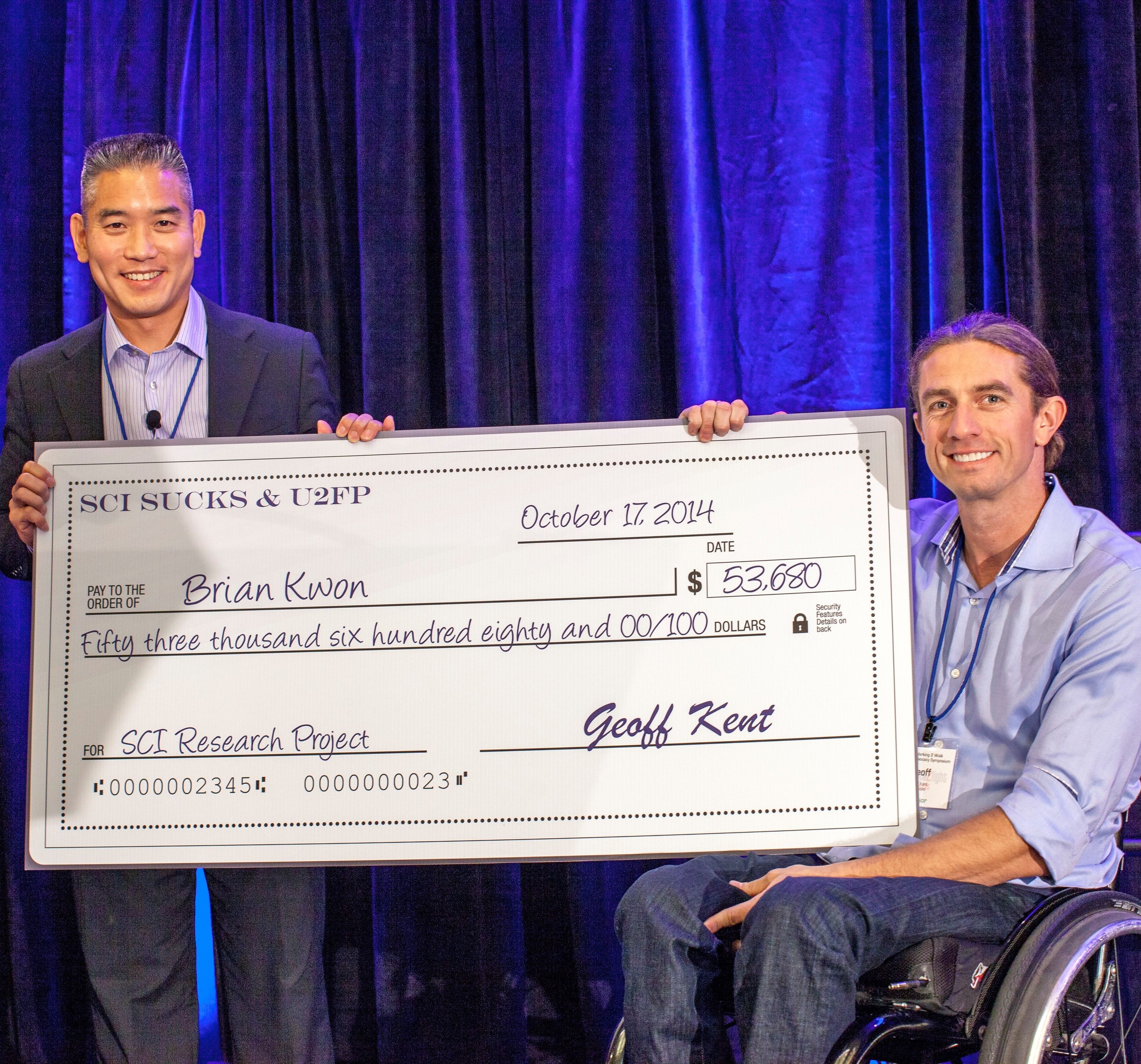
Former SAB member Brian Kwon, PhD, FRCSC, MD (left) with Geoff Kent (right).
But money in hand, how were they going to invest it? Kent wanted to be accountable to donors and he wanted the money to have a real impact, so he further aligned with U2FP to establish the SAB.
The SAB, managed until 2018 by Donna Sullivan, my predecessor at U2FP, comprises prominent SCI scientists and clinicians who offer independent review services at no cost to SCI charities and foundations seeking expert research guidance.
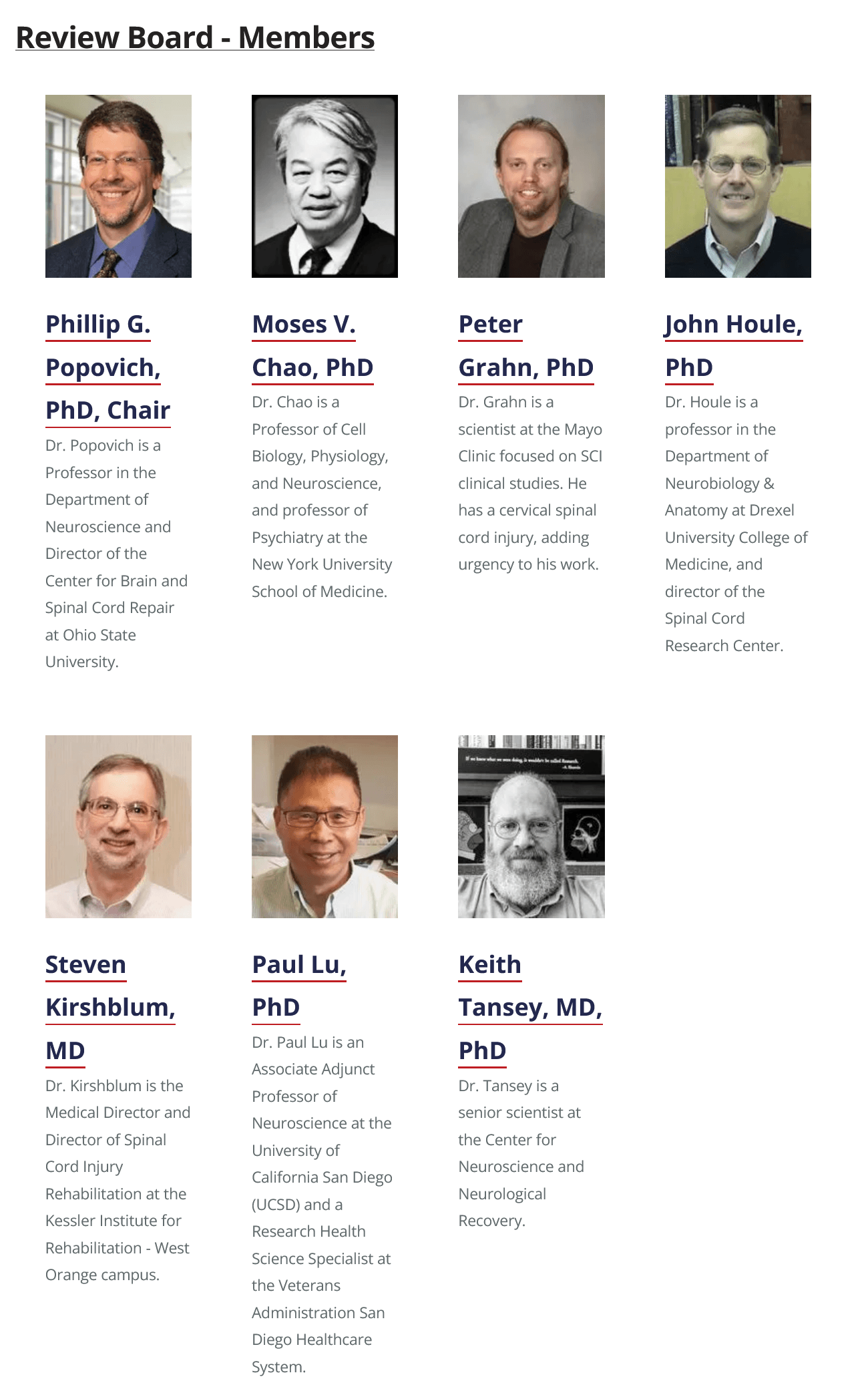
There are currently seven members of the SAB, who are paid for each review they perform. When a funder requests a SAB review, we require a proposal, detailed enough to state the problem, hypothesis, methodology and relationship to chronic SCI.
The proposal is sent to two reviewers (blinded to the funder) who evaluate the proposal scientifically but also consider the following: is the idea fresh, is the investigative team solid, does the work matter for people living with SCI, does its cost seem reasonable?
If both reviewers agree that the project merits funding, the project passes. If one or both reviewers say the proposal is not suitable, the funder can forward review comments to the originating research team. Sometimes concerns are addressed, or explained, and the proposal is resubmitted. Reviewers may be satisfied with the response and may then change their vote to approve.
Two hard no votes mean the SAB does not recommend funding. If one review is yes and the other an unequivocal no, we send the proposal to a third reviewer, to break the tie.
Alas, in the post-COVID era, the SAB has not been as busy as it once was. One reason may be the costs of doing experiments; smaller non-profits can’t raise enough funds from golf events or galas to underwrite a proposal that would clearly move the needle on progress. Nonetheless, the SAB is on-call if you or your funding organization need help vetting a research project.
*Note: In 2015, Geoff Kent folded SCI Sucks and asked Unite 2 Fight Paralysis to take charge of the SCIS racing team, and it continues to grow. The most recent Chicago Marathon occurred in October, with 28 Team U2FP runners and 2 wheelers raising a record setting $55,595 for U2FP advocacy programs.
A Proposal to the SAB for Regeneration of Chronic SCI
This story starts with a fascinating 2023 paper, “Recovery of walking after paralysis by regenerating characterized neurons to their natural target region,” which is the work of scientists Mark Anderson and Jordan Squair. Anderson and Squair are part of the SCI-focused group led by Grégoire Courtine at the École polytechnique fédérale de Lausanne (EPFL) in Switzerland. The paper made an immediate impact, which I covered at the time here. Anderson and Squair were on the CureCast (listen here) and Anderson also spoke at U2FP’s 2024 Annual Symposium (see his talk here).
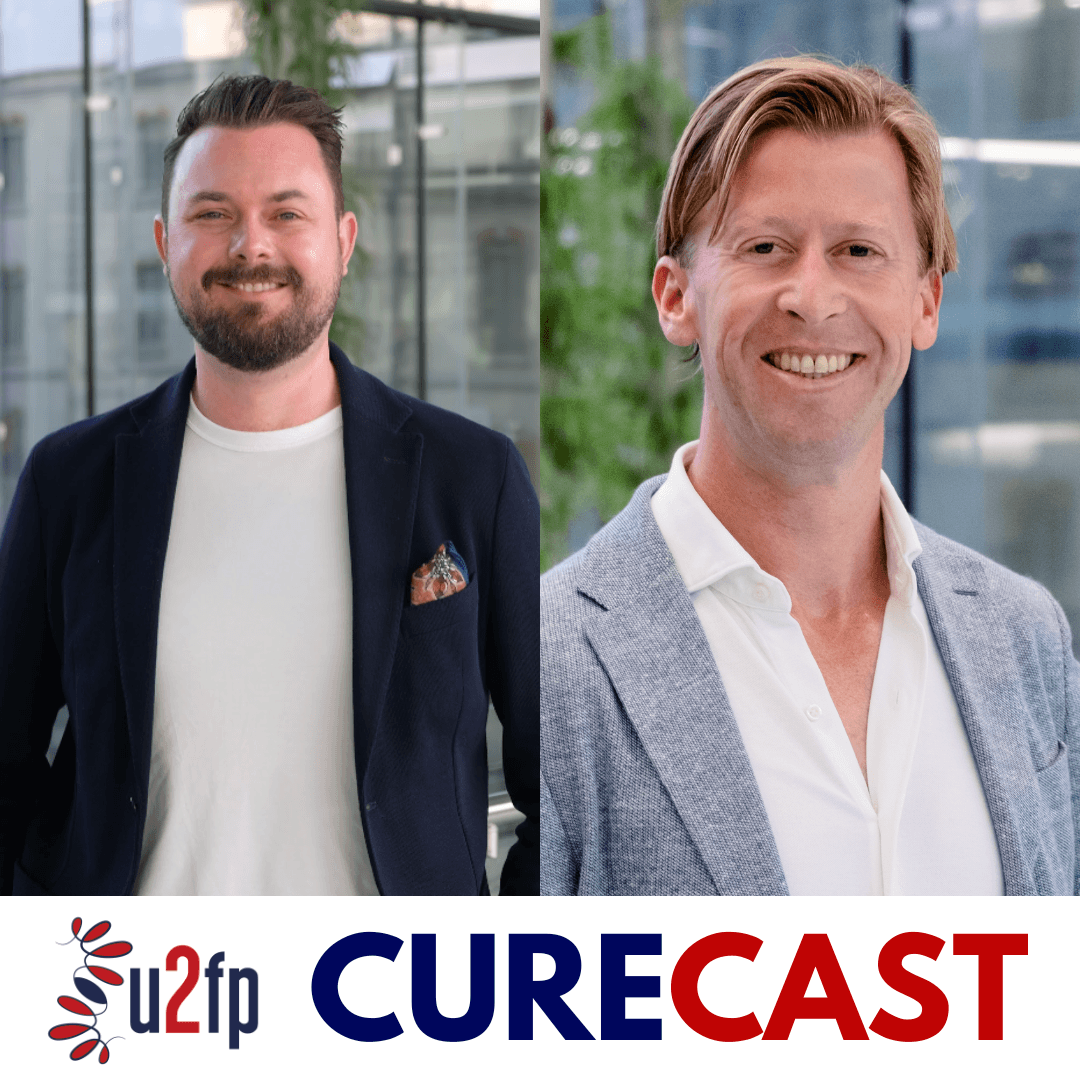
Jordan Squair, PhD (left) and Mark Anderson, PhD (right) appeared on CureCast Episode 97 to discuss their 2023 Science publication mentioned above.
Corinne Jeanmaire is the founder of Netherlands-based endParalysis (EP), and is an insurgent cure warrior who is at the heart of this story. She was spinal cord injured in Indonesia in 2001 and told at the time “you have to learn to suffer.” Jeanmaire wasn’t having any of that, not only because the message was cruelly insensitive but because it was oblivious to what was already happening in SCI therapy development.
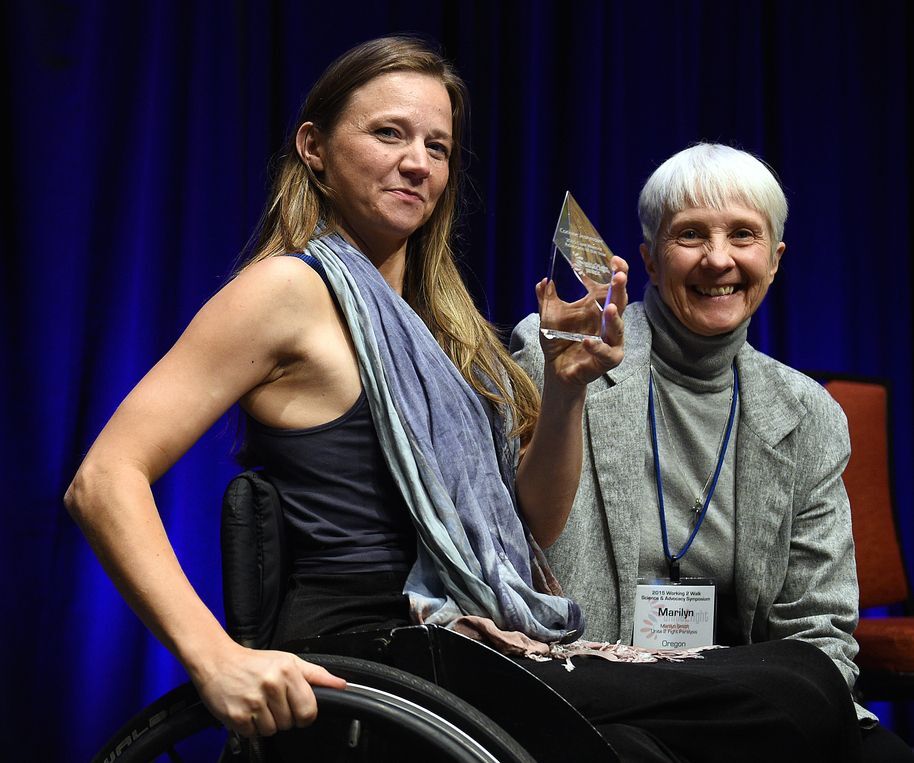
Corinne Jeanmaire (left) with U2FP founder Marilyn Smith (right)
Jeanmaire schooled herself in SCI research. She joined the CareCure forums online, and participated in the U2FP Science and Advocacy Symposium several times. She came to recognize that lack of progress wasn’t strictly a scarcity of money for research, it was also a sluggish funding bureaucracy that did not match priorities to the needs of the community.
Jeanmaire embodies the same sense of urgency that fuels U2FP. I asked her for some background on her charity:
In 2014, I created the endParalysis Foundation because there was no organization focusing on regenerative research after chronic SCI where I live, in the Netherlands. I knew that however small we would be, we could add value. We had to act smart though, and not reinvent the wheel. The idea was always to establish global partnerships (which we did, starting with U2FP in the US and with ISRT/Spinal Research in the UK). We select very targeted research projects according to our very specific criteria: chronic, biological, and clinically relevant.
Over the years U2FP’s SAB has evaluated several SCI research grants for EP. The organization has no paid staff; operational costs are paid by board members. All donations fund science.
In 2023, Jeanmaire read the Anderson regeneration paper and was impressed by its approach to SCI biological repair. She wondered if there was a role EP could play to move it forward. Mark Bacon, former director for the UK charity Spinal Research and now EP board member, heard Anderson discuss the paper at a 2023 conference. Bacon told Anderson EP wanted to support the work. Anderson sent over a proposal.
Anderson’s proposal:
My group pioneered a gene therapy based regenerative treatment which restored walking following anatomically complete acute SCI in mice (Squair et al, Science 2023). This therapy consists of i) activating intrinsic growth capacity in neurons above the injury, ii) providing growth permissive substrates within the core of the injury, and iii) chemoattracting axons to their natural targets below the injury. With generous support from the endParalysis Foundation, we studied whether this strategy could be successful in promoting axon regeneration and restoration of function following chronic anatomically complete SCI in mice. When administered four weeks post injury, this strategy failed to yield any improvement in axon regeneration or function. This is most likely due to the dense and fibrotic nature of the lesion core, creating an environment impermissible for axon growth.
Developing effective biological repair strategies for chronic SCI is an urgent and unmet medical need. Our proposed study on incomplete SCI in nonhuman primates is important for three main reasons. The first is clinical relevance. Any future initial human trials will involve patients with moderate to mild SCI (ASIA C or D). The second is feasibility. Gene therapy interventions in humans will need to be limited to a single treatment, at least in initial trials. Third is the necessity for a chronic injury. Patients enrolled in the trial will need to be in the chronic stage of the injury to ensure that they have reached a plateau in neurological recovery before assessing regenerative treatments.
Here's Jeanmaire:
We were immediately intrigued by Anderson’s approach. Their proof-of-concept combined gene therapy with other enabling strategies to restore function in mice with acute SCI by targeting critical neuronal connections, rather than attempting to regenerate the entire system. While being extremally focused, they were applying a multi-modal approach, e.g., they recognized that regenerating axons alone isn’t enough—guiding them to the correct destinations via ‘chemo-attraction’ is essential.
When tested in mice with chronic injuries, the therapy showed limited effect on “complete” injuries (likely due to an impenetrable fibrotic scar, which is a recurring issue that needs to be addressed), but encouraging results with incomplete injuries. We asked Dr. Anderson to propose the next translational steps. He recommended testing the therapy in non-human primates to better model human injuries and yield more clinically relevant data. This is a significant, costly step that should accelerate progress toward human trials.
EP has now funded two projects with Anderson, the first in partnership with Minnesota SCI charity GUSU (Get Up Stand Up). That study, which cost 50,000 Euros, was reviewed by EP’s own science advisors; it tested Anderson’s combination therapy on mice with chronic complete injuries. It did not yield significant recovery. Anderson suspected fibrotic scar inhibition.
From Anderson:
While the initial idea of promoting growth through anatomically complete lesions (the focus of the initial grant) did not work, we did find that in anatomically incomplete lesions, we could achieve nice growth around SCI lesions that restored function (walking). Given this exciting result, I told Corinne that we would like to begin developing chronic SCI models in nonhuman primates (NHP) so that we could test interventions such as this. She was supportive, which brings us to the current project.
This NHP project, at 40,000 Euros funded solely by EP, was reviewed by two members of the U2FP SAB. One review was a yes, with some concerns about experimental design. The other was a no, with several concerns about safety and side effects.
Both reviewers questioned whether three animals, as proposed, would be enough to statistically power any result.
More from Anderson:
We have performed around 20 incomplete crush SCIs in NHPs to date. While inherent variability does exist, as in any incomplete SCI model, this is relatively minimal. Regarding the number of monkeys (n=3), we feel that this number is sufficient to gather proof of concept evidence that stimulation of propriospinal axons may promote their regeneration and improve recovery of walking in a NHP model of chronic incomplete SCI. Further, the reviewer(s) should note that this grant is for 40,000 euros, which is a modest but important contribution to this project. The actual cost of the proposal is several times this cost.
The back and forth between the reviewers and the Anderson lab covers the animal model, the type of injury and whether it is humane to partially paralyze nonhuman primates. See this link to view more of the Anderson/Reviewer exchange and to get a sense for how this process works.
With consensus from the U2FP reviewers, EP validated its approach and funded the Anderson lab’s regeneration study. It’s a small project, only three animals, but could lead to important discoveries pushing the project forward. Both Jeanmaire and Anderson promise to update us as things evolve.
Stay curious,
Sam Maddox, Scientific Advisory Board Director
Unite 2 Fight Paralysis
PS - The SAB doesn’t call attention to itself nor is it a particularly marketable program. But it is important. Consider making a year-end gift to U2FP to support this and many other efforts we’re making to accelerate functional recovery for the SCI community.