October 29, 2025
Headline Patrol: NVG-291 Redux
Sam Maddox
Before we dive in, here's a note from Matthew Rodreick, U2FP's Executive Director:
We are re-releasing the following Headline Patrol piece which was originally published on October 23, 2025. Amidst the usual positive feedback, Sam's article also received several messages that misunderstood the section on the NervGen trial as a criticism of the company and the trial. This couldn’t be further from the truth. We are very supportive of NervGen’s work and passionate efforts to gain FDA approval.
A reminder: U2FP’s Headline Patrol series is our effort to contextualize and unpack ‘breakthrough’ news stories about SCI treatments and, when necessary, critique the media’s coverage so that our community remains informed.
Science journalism is all but dead in the mass media and our community needs more critical analyses that respect their intelligence, allowing them to make up their own minds on whether to hold promise for therapies that could directly affect their lives. This means identifying missing information, pointing out necessary context and sometimes correcting misleading statements or misunderstandings by the news media (i.e. could the subject walk before the trial started? and how are they defining walking?).
It should also be acknowledged that the SCI community represented online often falls into two competing camps: those who think restorative research has been a waste of money and we should give up, and those who are uncritical enthusiasts for any new therapy that gains traction in the media. U2FP’s goal in this divided online space is to foster the small but growing segment of the SCI community who is looking for informed hope. And this requires the skepticism that good journalism can deliver.
We will be releasing a CureCast podcast interview with one of the Connect SCI Trial participants in the coming weeks to discuss the trial, the media’s coverage of the trial and why we elected to write the recent Headline Patrol piece. Watch for it coming soon.
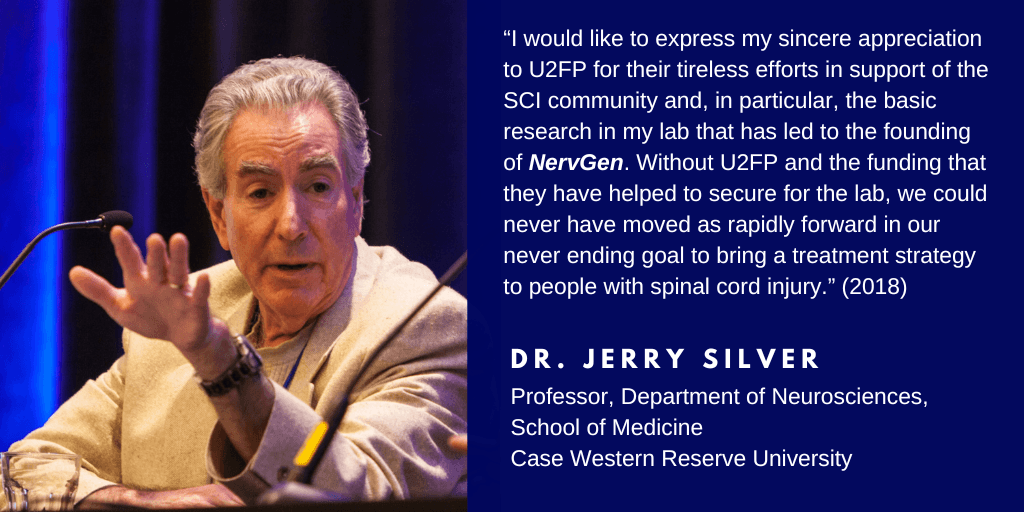
Please note: we will be honoring the passing of Dr. Silver at our upcoming Science and Advocacy Symposium in February.
In the meantime if you want more background on NervGen, check out these presentations and past interviews:
- U2FP’s CureCast Interview with Jerry Silver, the scientist who developed NVG-291
- Daniel Mikol’s presentation at our 2024 Science and Advocacy Symposium on the design of the clinical trial
- U2FP’s CureCast Interview with Paul Brennan, former NervGen CEO, and Harold Punett, co-founder of NervGen, whose daughter-in-law has an SCI
And to get a better understanding of what our Headline Patrol series is trying to accomplish, listen to this interview with our Science Writer, Sam Maddox.
As always, thanks for your feedback and ongoing engagement with our work.

Matthew Rodreick, Executive Director
Unite 2 Fight Paralysis
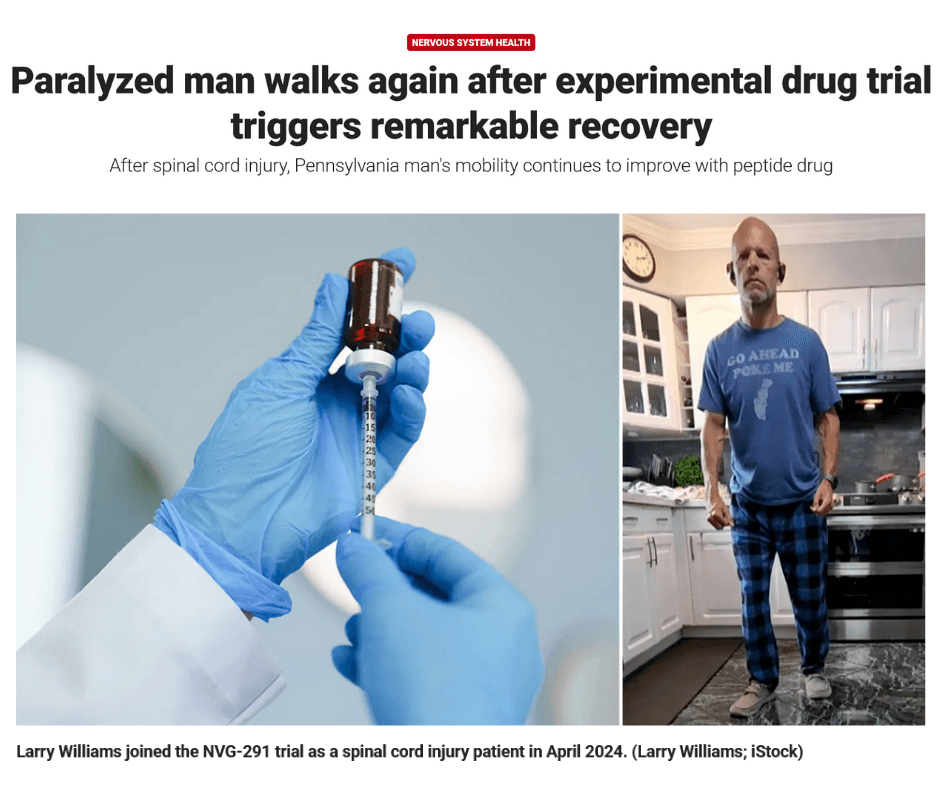
Here's a recent headline that you may recognize as a familiar rehash, Paralyzed man walks again after experimental drug trial triggers remarkable recovery.
Nothing new here, just a new headline, five months post facto. This is about a guy who was in the Connect SCI Study, a clinical trial testing NVG-291, an injectable peptide drug that is intended to promote natural nerve growth by unblocking damaged pathways.
We’ve covered this drug for more than a decade, from its very beginnings in the lab of the late Jerry Silver, as animal studies affirmed its efficacy, as a company was formed (NervGen) by a Vancouver dentist to develop the drug, as Fast Track designation came from the FDA, as a human trial was designed and paid for, as participants were recruited, and as the first results were disclosed.
This past July we reported that NervGen, the company that licensed the peptide from Silver’s lab, presented early data from the first 20 patient cohort – people with chronic cervical motor incomplete spinal cord injury. (A second cohort is still recruiting people with very recent injuries, within 20 to 90 days of injury, see trial detail here.)
The company noted that the first group met a key trial goal, demonstrating improved motor connectivity, a three-fold increase in an electrical measurement of a hand muscle signal. In a clinical trial, meeting an endpoint is a win. But what does it mean clinically? What does it mean to the trial participants? Did anybody regain anything?
Yes, there was measurable recovery, but no, it wasn’t considered meaningful statistically. The study measured grip and grasp strength while pouring water into a cup or inserting a key into a lock and turning it 90 degrees. These so-called qualitative prehension tests “trended toward beneficial effect” (7 in 10 got better than those in the placebo group) - but not enough for the investigators to make any claims that this treatment boosted function.
Didn’t NervGen say that two in the drug group could initiate a walking test at the end but could not do so at the beginning of the study? Yes, but the company also said this is likely due to the daily physical therapy the trial included. They noted that one person in the placebo group (no drug) also got a big increase (1200 percent) in walking speed, which cannot be explained.
Social Media Chimes In
While the results do not convincingly translate to functional gain, several trial participants have gone public to share some improvements. In this placebo controlled and blinded trial, half the patients got the drug, half got a dummy drug. The blind was lifted in June and we know who got what. One of those who got the drug is Larry Williams, 58, of Philadelphia, who was mentioned in our coverage. He has been very public about his participation, using his Facebook page to update his situation. A local Fox News reporter heard about him earlier this month, reprising his story and promoting the “remarkable recovery,” per our nominal headline.
Fox News did not report this, but Williams could walk before the NVG-291 trial. Afterwards, he could walk faster, going from 45 to 15 seconds across 10 meters. He says he continues to get something back, even though he’s not actively doing any training. "I'm not working out really hard. I'm currently not in therapy," he told Fox. "But just a couple of days ago, I stood up and tried to free-stand, balance and lift one foot off the ground. I was able to do it for 30 seconds. I hadn't been practicing this.” Six months earlier Williams said he couldn’t hold his foot off the ground for even three seconds. “I can't explain how it happened,” said Williams.
Williams wants more of the drug. He told the Fox reporter he has been trying hard to get access to a second round of NVG-291. He appears to be eligible; NervGen announced an expanded access policy earlier this year, allowing trial participants who got the drug in the trial to get more, with a physician’s OK. "I'm not going to give up. I'm going to keep pushing and trying,” Williams said.
I urge you to stay an insatiable but careful consumer of SCI news stories. It’s not getting any easier. Sometimes it takes a lot of wheelspinning to muck it out, without much reward. In this NervGen story we see local reporting going national, with no actual news – only another 'paralyzed man walks' headline. You want these stories to take you somewhere that feels like hope or progress but then you discover there’s not much that's new in the coverage. Science is seldom tidy and neither is journalism. We’ll keep the radar on. You too.
Stay curious.